
Coppell Previous Residents by Era
Different sources answer different parts of an address question. County deed indexes connect recorded parties to a legal description and document date. A directory or street guide can show a dated listing at an address. City permit and archive material can place municipal activity at the site. Census, obituary, probate, cemetery, and oral-history material may corroborate a household trail. Coppell's split between Dallas and Denton counties matters at every stage. Confirm the parcel's county in the city map or a CAD result before choosing a clerk, a deed portal, or a research room.
| Source | Years it covers | Where held | What it can show |
|---|---|---|---|
| Dallas or Denton official-record index | Online start dates not located | Matching County Clerk portal and historic materials | Recorded parties, document number, legal description, recorded date |
| Denton county directories | 1920-1991, sporadic | Denton County Research Room | Dated name, street-order, and business clues where included |
| Polk's Greater Dallas directory | 1961 volume | Portal to Texas History | Regional listings, residence notation, street guide, and page image |
| Coppell permit and archive reports | Dates vary by record | City Civic Access and Archive Center | Permit, inspection, project, parcel, and dated municipal activity |
| Census and local-history evidence | By collection and release rules | Research databases and local repositories | Independent household or family-history corroboration |
Start with the source closest to the date in question. For a recent recorded transfer, use the matching county's official index. For an older address clue, look for a directory page or Research Room lead first, then check the legal description through deeds. Do not read an online portal's freshness date as its first year of coverage. Both official county pages left exact online start dates unresolved in the research, and older physical or microfilm material can be available through a different channel.
Coppell Past Households Across Counties
One city name does not mean one record system. Coppell spans Dallas County and a smaller part of Denton County. The city tax and map resources point readers to both appraisal districts, and each county has its own CAD, County Clerk, official-record portal, court path, and historic material. A Coppell mailing label is not enough to choose between them. Use the county line in the Coppell Engineering map, the parcel's situs result, and its legal description to route the address before beginning a previous-residents search.
County confirmation also prevents a false no-match. Dallas CAD address search has its own parser rules, while Denton property search treats the property location as the situs and omits street type and direction. A Denton-side parcel can be found with an R Number from the GIS guide. For the full current-address process, the Coppell street directory has the address-focused workflow. Here, keep the county name next to every older deed, directory, permit, or copy request so the backward trail remains traceable.
Note: Record the county, parcel identifier, legal description, source date, and retrieval date before comparing any names attached to an address.
Coppell Past Households in Denton
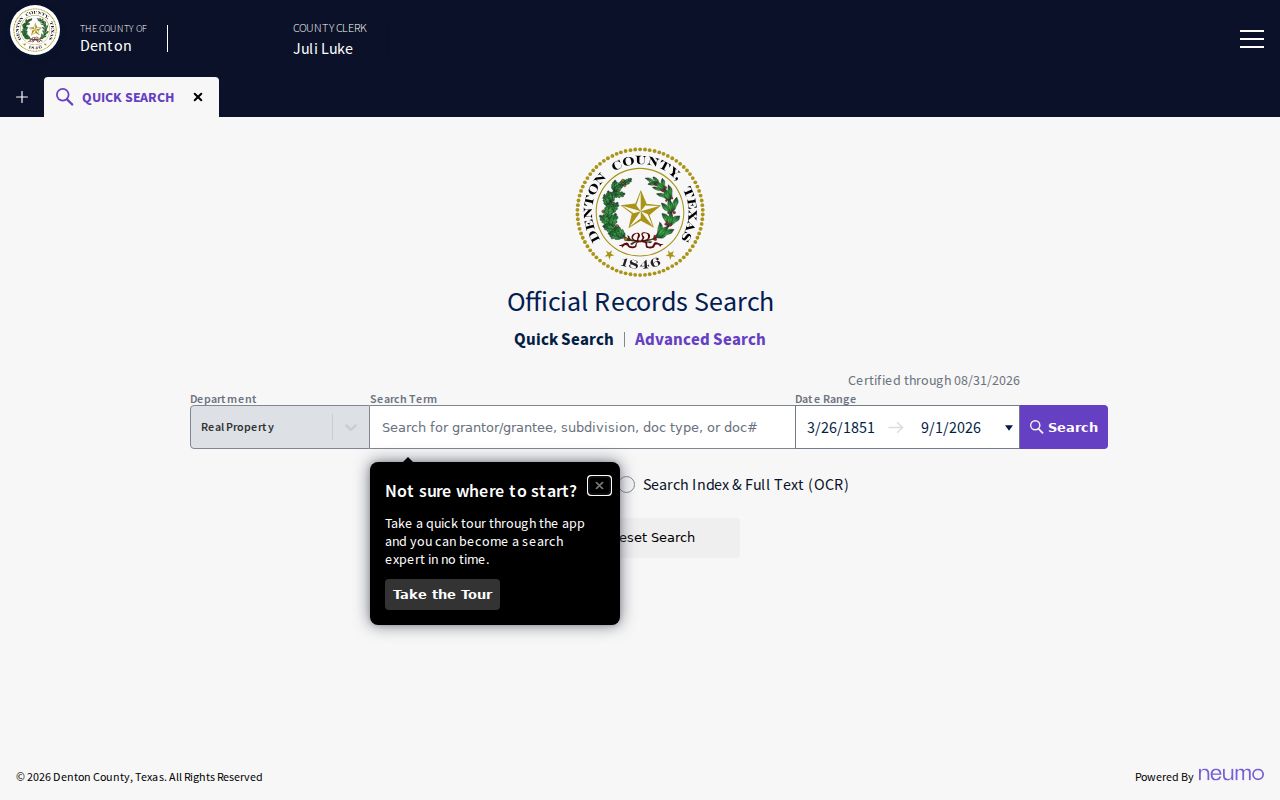
For a parcel in Denton County, the Denton official-records search is the first deed-index route. Its captured controls include Department, Search Term, Recorded Date, quick ranges, Index Only or Full Text/OCR, and Quick or Advanced search. The portal states that searches can use a grantor or grantee, subdivision, document type, or document number. At capture, it displayed a certification date of August 27, 2026. That date is a freshness marker, not a promise that every older record is online.
The Denton County official-records search provides the page shown below, including its Quick Search and Advanced Search entry points.
When a hit appears, preserve the document number, recorded date, parties, and legal description before ordering a copy. The Denton County Clerk's Recording Division receives documents at 1450 E. McKinney Street, Denton, with recorded hours of 8:00 a.m. to 4:30 p.m. on weekdays. The County Clerk lists mail payment methods and electronic-recording partners, so the portal is not the only route when an image or earlier material is missing.
Coppell Address History in Dallas
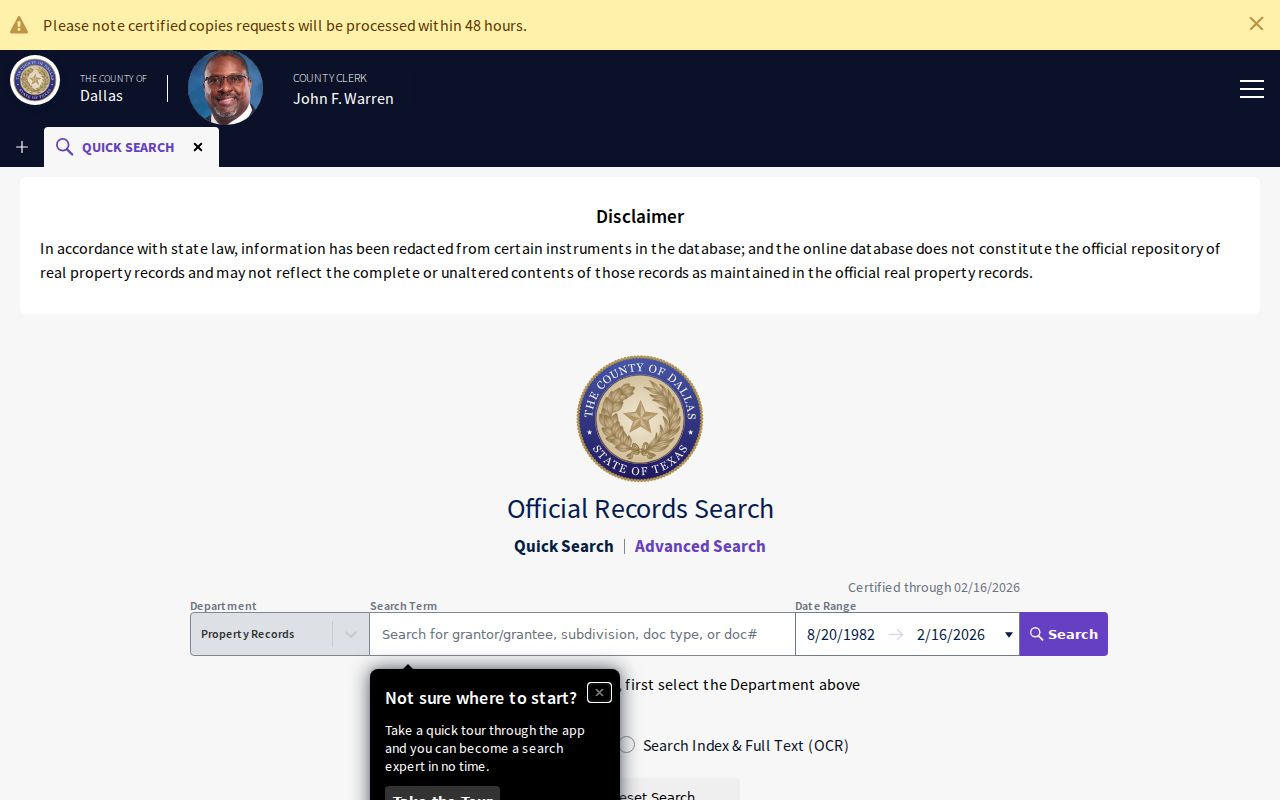
Dallas County is the principal county route for Coppell, but it remains essential to verify the parcel first. The Dallas Official Records Search has Quick Search and Advanced Search, a required Department and Search Term, a recorded-date range, quick ranges, and a choice between index-only and index-with-full-text OCR. It displayed certification through February 16, 2026 during the research capture. Search a party, date range, legal description, subdivision, or instrument number with a documented reason for each variation. A result identifies a recorded instrument; it does not settle who occupied the property on that date.
The Dallas County official-records portal is the source for this search interface.
For a copy, the Dallas County Clerk's Recording Division is in the Records Building at 500 Elm Street, Suite 2100, Dallas, and the published phone number is 214-653-7099. The official document-request form accepts recorded name, grantor or grantee, instrument number, document type, property address, and requested copy type. Central Records describes historic deed and microfilm material with online and in-person coverage that varies by record family and year. A gap on the screen should therefore lead to a clerk or Central Records inquiry, not a conclusion that the older document never existed.
Trace Coppell Deed Chains Backward
A deed chain is a sequence of recorded transfers tied together by the legal description, not merely by a street address. Begin with the current parcel record, then move backward from the buyer's deed to the seller's earlier purchase. Both county portals support party and date searching, and both offer index-only or OCR-assisted options. Run the search in the matching county and log each document. If the chain reaches a portal gap, move to the clerk's older holdings or request the instrument with the details already collected.
- Confirm the county, current situs, parcel or R Number, and legal description in the matching CAD record.
- Find the latest recorded purchase or transfer in the County Clerk's official index and save its document number.
- Read the grantee and grantor roles, then search the seller as a grantee to locate that party's earlier acquisition.
- Repeat backward while matching the legal description, lot, block, subdivision, or other land description across each instrument.
- Use the clerk, historic holdings, or document request route when the needed record predates the available online material.
- Grantor and grantee
- The grantor transfers an interest; the grantee receives it in the recorded instrument.
- Chain of title
- The documented sequence of transfers for the same described property, read backward from a later record.
- Legal description
- The lot, block, subdivision, tract, or similar land description in a deed. It is more stable than a street label when an address changes.
Dallas County's request instructions also call for a prepaid self-addressed envelope when applicable. Denton County lists mail and electronic recording channels. Those details matter when a researcher has the instrument data but the needed copy or earlier entry is not visible online.
Coppell Previous Residents in Street Guides
Deed parties are not the whole household trail. The 1961 Polk's Greater Dallas City Directory includes a complete street guide and example entries with relationships in parentheses, occupation or business detail, and residence notation such as “r Coppell Tex.” A street guide can supply a dated address clue, then the alphabetical pages can be read for the exact printed details. The Coppell city directory collections page explains the historical shelf and how to preserve an entry. Treat the regional volume as evidence of its stated coverage, not as a complete roster for Coppell.
The example 1961 directory page shows the kind of printed entry and Coppell residence notation that should be checked as an image rather than trusted solely through OCR.
Copy the page number, year, address wording, and role before comparing it with another source. The Denton County Research guide recommends searching an address year by year before following the surname index. No exact Coppell reverse-directory run was located, so do not assume that an address will appear in every year or that a missing listing identifies a move.
Coppell Address History and Permit Dates
Coppell's municipal records can add a dated event to an address trail without naming a full household. The Coppell Archive Center offers keyword, category, time-period, and date-range filters. Its published categories include Building Permit Reports, Planning and Zoning active-case logs and maps, newsletters, and other municipal reports. The city also directs permit work through Civic Access, formerly CSS, while Building Inspections is at 265 E Parkway Boulevard and lists 972-304-3500. A permit or inspection can show an application, issue, inspection, final date, zone, parcel, valuation, or description, depending on the record.
Use these fields to establish activity at a place, not to assign a person to it. A permit is not a resident roll. It may identify construction, demolition, repair, or an inspection timeline that can be compared with an address in a directory or the legal description from a deed. City Planning files are maintained in Laserfiche, and a focused Texas Public Information Act request can name the address, project or permit number, department, and date range. The Texas Public Information Act does not require a requestor to give a reason, but confidential material and separate court-record rules remain in place.
Coppell Past Households in History
Historic-house work benefits from a place-first sequence. The Coppell historic-resource survey applies a 50-year framework and notes that many World War II and postwar neighborhoods may now merit historic attention. The Coppell Historical Society identifies the Kirkland House, built in 1904, as the oldest remaining house. Bethel Cemetery and Grapevine Springs are additional genealogy and landscape leads. Start with an address and legal description, then connect deeds, permits, directory pages, a survey reference, and a named cemetery or oral-history source only where each is available.
The local story also has changing names. City history traces Grapevine Springs to 1832, the Gibbs name by 1887, Coppell by 1890, and town and post-office status in 1892. Older sources may use those labels differently from current city boundaries. Denton County's 1875 courthouse fire was a county-record loss, not a Coppell courthouse event. Do not use that fire as an explanation for a missing local record unless the particular county source supports it.
Note: Historic research should preserve each source's date, role, collection identifier, and release status before linking a person to an address.
Pair Coppell Directories With Census
A household timeline needs more than a deed chain. Pair each available directory year with a census schedule or another independent source from a compatible period. Then compare the street wording, county, name variants, and role. A directory may list a residence notation, while a recorded transfer identifies parties and a permit establishes municipal activity. Census, obituary, probate, cemetery, newspaper, and oral-history material should corroborate rather than replace those dated records. Keep owner, occupant, business, mailing address, and requester roles separate throughout the log.
- Set out a timeline with the address form, county, and legal description at the top.
- Add each recorded deed with its document number, date, grantor, grantee, and matched land description.
- Add directory and street-guide entries by year, preserving their page images and printed wording.
- Pair a dated household source with the closest directory or address evidence, noting any conflict.
- Mark a record as missing, restricted, index-only, or portal-error when that is the actual outcome.
Lawful use. Coppell house-history and family-history research should respect protected fields and personal boundaries. Do not use a past-resident trail to stalk, harass, or track a living person.