
Coppell Resident Lookup Sources
Coppell sits mainly in Dallas County, but a smaller part of the city reaches Denton County. That split comes first. A Dallas address can call for Dallas Central Appraisal District and the Dallas clerk, while a Denton-side parcel can lead to Denton CAD and the Denton County Clerk. Neither chain is a master roster. Each record is a dated trace with its own purpose. Property data can identify a public owner or mailing address, a docket can identify parties to a case, and an archival index can help distinguish an earlier name or relationship.
| Record trail | Useful confirmation | Custodian or portal | Access path |
|---|---|---|---|
| Parcel account | Public owner, situs, legal description, parcel identifier | Dallas CAD or Denton CAD | Public search, with protected fields excluded |
| Recorded instrument | Parties, recorded date, document number, legal description | Matching county clerk index | Index first, then request a copy if needed |
| Court docket | Case number, party role, court, hearing or filing detail | Denton Justice1 | Public entries can omit sealed matters |
| Vital index or order | Eligible event verification or historical index clue | Texas DSHS | Access changes by record type and age |
| State affiliation record | License or entity filing context | TDLR or SOSDirect | Use as context, not residence proof |
Begin with the source that fits the fact already known. An address belongs in the CAD search and city map first. A case number belongs with the court that issued it. A dated family-history question may call for an index or qualified vital-record request. Keep the county, retrieval date, record date, person’s role, and a confidence note together. That small log prevents an appealing name match from turning into an unsupported identification.
Coppell Court Lookup Checks
For a Denton-side matter, the Denton court docket service describes results with hearing date, time, location, case number, parties, and court. Justice1 supports court, date, and name pathways. Try exact and partial name forms, then narrow by court type and date interval. Record a party role separately from an attorney name. A calendar entry only records a scheduled event, and a docket is not a final result unless the underlying disposition or order supports that conclusion.
The Denton judicial public-access landing page is shown below. It is a useful starting point for the correct court channel, but sealed and statutory-confidential matters are not available there. Dallas matters require the county’s record-search hub, where clerk and district-clerk records are routed separately.
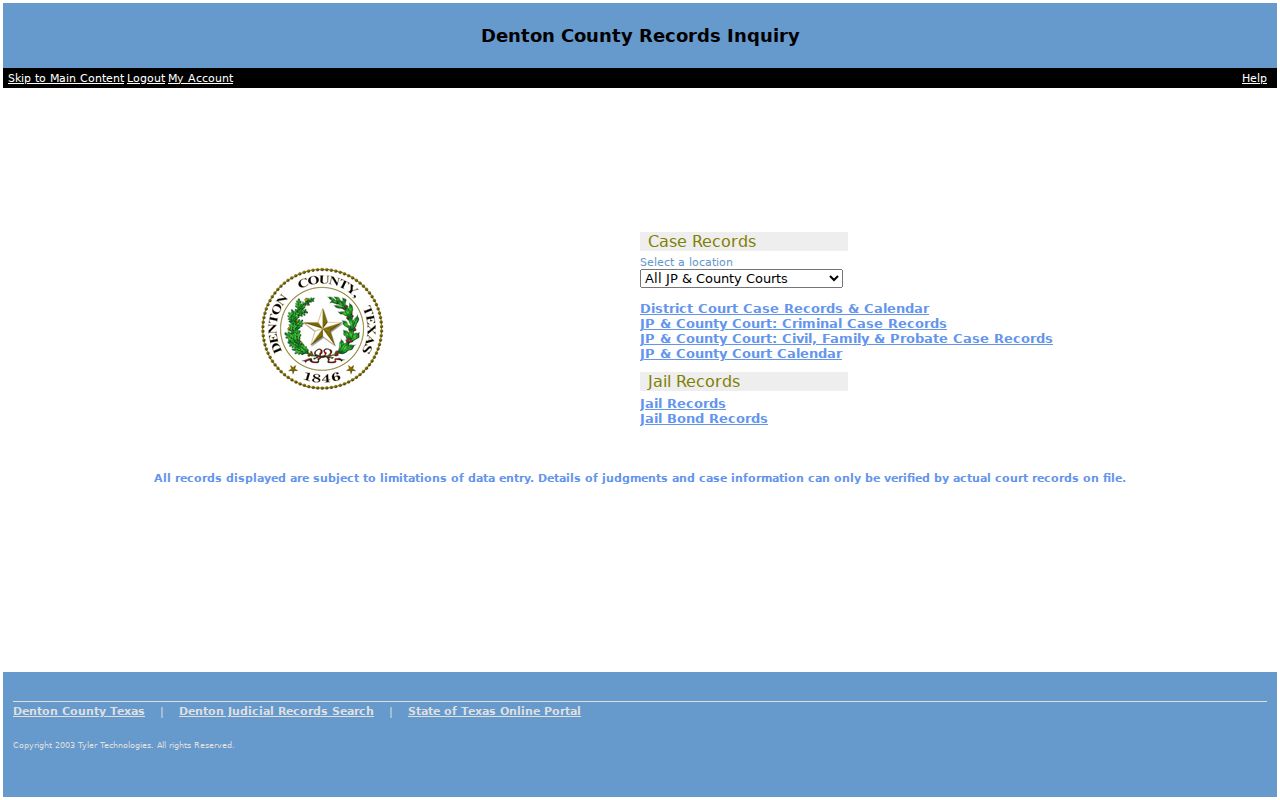
Use the displayed portal as an index to a court record, then preserve the cause number and court with the result. A missing hit can mean a different county, a restricted file, an unintegrated case, or a search variation that needs another pass.
Note: A court-party result is an identity lead, not proof that the named person is the Coppell resident being researched.
Coppell Lookup Name Variants
Use three independent anchors before treating records as one person: a consistent date or era, a location or legal description, and a second record with a compatible relationship or case detail. Search the full name, surname variants, initials, middle names, and punctuation variants. The Dallas CAD owner search asks for a full last name and at least two first-name letters. Its help also notes that a surname such as McDonald may need a spaced form, and that the percent sign works as a wildcard.
Do not merge records merely because both say Coppell. CAD owners can be trusts, companies, or mailing names. Recorded deeds can arrive after a transaction. A voter entry may be stale, and a historical directory is a dated snapshot. When an address is involved, use the public city map to confirm city limits and county line, then compare the situs and parcel identifier in the appropriate CAD record. For a broader address chain, the Coppell street directory keeps that process focused on the street rather than one name.
Verify a Coppell Resident Lookup
A careful confirmation starts by anchoring a person to a record with a clear date and purpose. The sequence below does not turn an owner into an occupant or a party into a present resident. It simply tests whether independently kept records line up. If the address lies near the city boundary, run the city map and parcel search before choosing the county court or clerk route.
- Search the public parcel record for the address and save its situs, legal description, and parcel or R Number.
- Search the matching county’s official deed index or court channel with the exact name and sensible variants.
- Compare dates, party role, case number, legal description, and any lawfully public relationship detail before treating the hits as connected.
- Request an official copy from the custodian only when an index result needs verification or a certified record is required for a personal matter.
- Docket
- A court’s running case record, which may list hearings and parties but does not by itself settle the case outcome.
- Index and image
- An index supplies finding details such as names and dates; an image is the underlying document when the custodian makes it available.
- Certified copy
- A copy issued and authenticated by the record custodian, distinct from an online search result or an informal printout.
Dallas County’s document-request form asks for identifiers such as grantor or grantee, instrument number, document type, and property address. That is why it is worth collecting the index details before ordering. The form also distinguishes plain and certified copies, and the county’s fees differ by copy type.
Coppell Lookup Vital Paths
Vital records are not a shortcut around identity limits. Denton County accepts online, mail, and in-person birth and death requests from qualified requesters for covered events. Its application asks for the subject’s full name, event date and place, parents’ names, requester relationship, contact information, identification, and authorization. The county says information cannot be verified by phone. Texas DSHS offers statewide order channels and separate marriage and divorce verification products, while certified marriage and divorce records remain with the county clerk or district clerk.
Texas Government Code §552.115 makes a birth record public after 75 years and a death record public after 25 years, subject to the rule for an unidentified deceased person. DSHS reports digital birth indexes from 1925 and death indexes from 1965, with earlier microfiche beginning in 1903. An index can point to an event, but it can contain omissions or typographical errors. Ask the right custodian for the right kind of copy and do not imply that a historical index establishes a current address.
Coppell Lookup Voter Boundaries
Vote Denton is the official county entry point for Denton-side voter services, but its live lookup fields and result behavior did not render during the research capture. That gap matters. Do not assume which form of name, birth information, VUID, or address the live tool accepts. Texas Election Code §15.001 identifies certificate information, while §13.004 protects or restricts copying of sensitive and protected voter data. A public voter record can help corroborate jurisdiction or an effective registration date. It does not prove current occupancy or ownership.
The Texas Secretary of State provides election data forms for statewide information requests. Protected voters may be absent from ordinary public systems. Treat a suppressed record or a substitute address as a privacy signal, not a gap to defeat.
Coppell Lookup State Context
State searches can add narrow context to a name. TDLR allows public searches by name, license type, city, and county. SOSDirect supports Texas entity and UCC searches by entity name or number, uses an account or temporary login, and lists a $1 search fee. A registered agent or principal office is a filing contact, not a person’s residence. Likewise, the Texas Comptroller’s ClaimIt search is a name-based claim path, not proof of a current address.
The Texas appellate case search offers case and document tabs, partial case number, civil or criminal selection, filing dates, style, attorney or bar number, trial county, and court filters. Its nightly refresh and completeness notice make the retrieval date part of the evidence.
A view of the Texas case-search interface appears here. Use its filters to narrow a known case, not to turn a broad statewide name result into a Coppell identity claim.
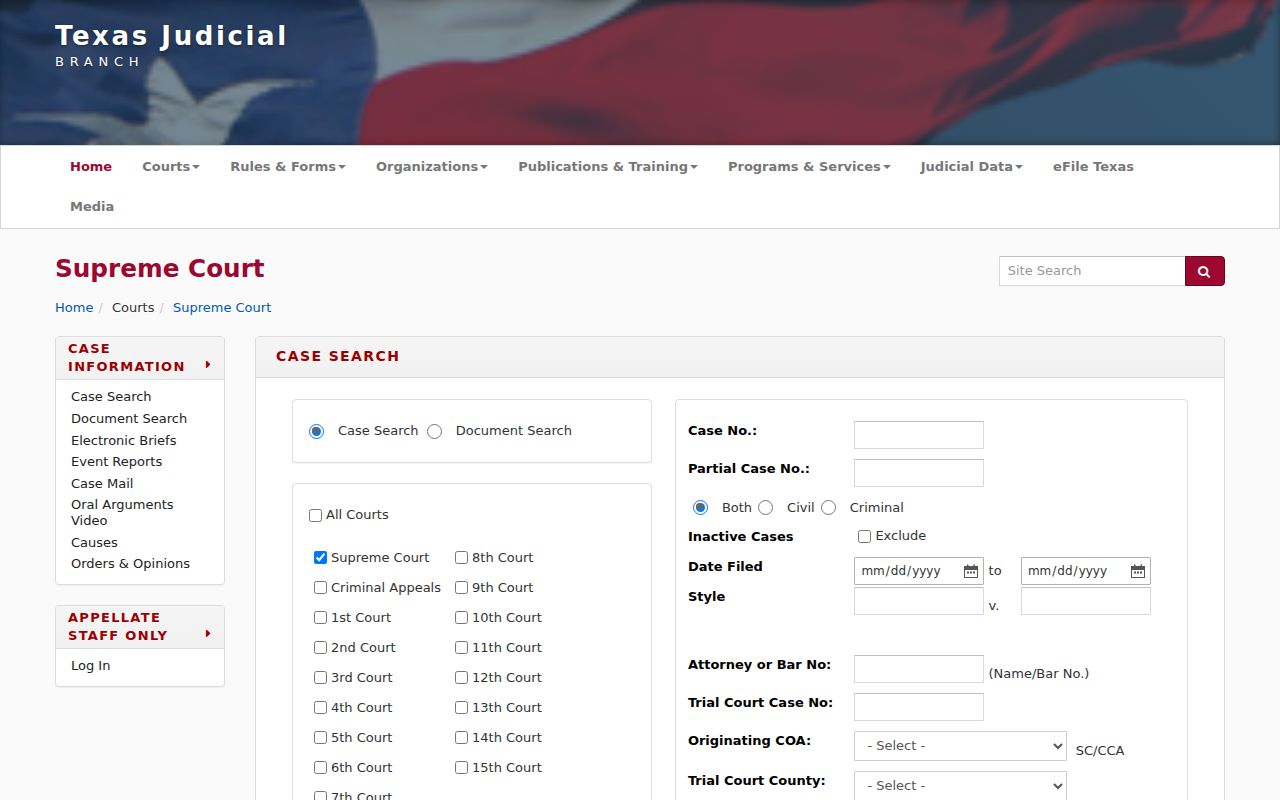
The search screen supports a cross-check after the county and case type are known. It is not the trial-court custodian for every record, so retain the county court source alongside it.
Coppell Custody Lookup Scope
Custody sources answer a separate, time-sensitive question and should not be folded into a general name match. Denton County’s official services page links jail-record and bond-record routes, while its Sheriff gives records-request channels by mail, email, hand delivery, and GovQA. The direct jail-search endpoint and live result fields were not captured in the research session. Dallas County official pages also route users to Jail Lookup, but the current direct endpoint was not exposed. Use the current county page rather than an old link copied from a past document.
The Texas Department of Criminal Justice search is a state-custody tool, not a county booking roster. It supports name, SID, current TDCJ number, partial searches with an asterisk, previous numbers, detail views, and notifications. The research source notes that a name match still needs independent identity support. When you look up a resident, label a result by its actual system and date instead of treating it as a complete history.
Coppell Lookup Results and No-Matches
Write down a no-match with the same care as a hit. Record the portal, county, date, exact query, variants tried, date range, and whether the result was empty, index-only, restricted, or an access error. “Not found in this portal on this date” is a useful research note. “Does not exist” usually is not. For a municipal file, a narrow Texas Public Information Act request should name the department, record type, date interval, address, case number, or permit number rather than ask the city to create a new report.
The Texas Public Information Act overview says a requestor generally need not state a reason. A governmental body that cannot produce records within ten business days should provide a reasonable date and explanation. Records can still be redacted or withheld under an exception, and Coppell Municipal Court records use a separate judicial channel. Those distinctions preserve the meaning of a no result.
Coppell Resident Privacy Limits
Texas access rules vary by custodian and field. The Texas Attorney General’s Address Confidentiality Program permits eligible survivors of family violence, sexual assault, human trafficking, stalking, or child abduction to use a substitute mailing address. The program generally runs in three-year periods with renewal. Do not try to reverse a substitute address. Protected voters, sealed court parties, restricted vital records, and confidential CAD fields likewise require restraint and a direct correction or confidentiality request to the actual custodian.
Lawful use. Use Coppell records for personal, lawful research and respect every protected field. Do not use a name, address, or record trail to stalk, harass, or harm anyone.
When a record is wrong, identify its source and ask the office that holds it about correction, redaction, or confidentiality. A private request cannot erase a valid county deed or court record, but a source citation and written disposition create a useful correction trail.